Table of Contents
- Why Layering Korean Serums Beats a Single Serum
- Korean Skincare Routine Order: Where Serums Fit
- The Thinnest-to-Thickest Rule for Layering Korean Serums
- How Long to Wait Between Serums (and When You Can Skip It)
- Ingredients to Avoid Mixing in Skincare
- Common Mistakes When Layering Skincare
- Layering Serums Under Makeup and on a Budget
- Frequently Asked Questions
Last Updated: September 30, 2026
Why Layering Korean Serums Beats a Single Serum
Layering Korean serums for maximum hydration means applying two or more lightweight, water-based serums in sequence so each one adds a different kind of moisture to your skin. One serum can only do so much. Several thin layers build hydration that actually lasts.
How Humectants, Emollients, and Occlusives Work Together
Think of these three as a team, not competitors.
- Humectants (hyaluronic acid, glycerin) draw water into the skin
- Emollients (squalane, ceramides) soften and smooth the surface
- Occlusives (facial oils, heavier creams) trap moisture so it stays put
Humectants go first because they need water to work. Emollients follow to smooth texture. Occlusives finish the job by sealing the barrier. Skip a step and hydration leaks out through transepidermal water loss, the process where moisture escapes through your skin's surface.
Korean Skincare Routine Order: Where Serums Fit
Serums sit in the middle of the routine, after toners and essences, before moisturizers and oils. This position matters because thinner products need to reach the skin first.
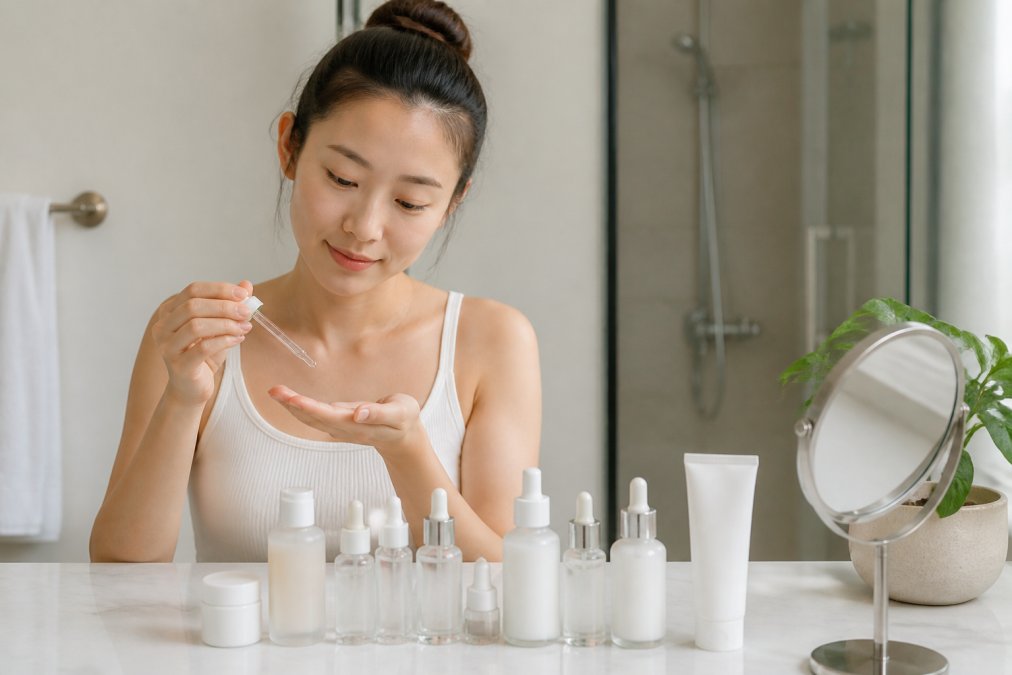
The full order looks like this:
- Oil cleanser
- Water-based cleanser
- Exfoliant (once or twice a week)
- Toner
- Essence
- Serum or ampoule
- Moisturizer
- Facial oil or SPF (morning)
The Thinnest-to-Thickest Rule for Layering Korean Serums
The thinnest-to-thickest rule is simple: apply your most watery product first and your richest product last. Thick products create a film that blocks anything thinner from getting through.
Here's how to sequence three serums:
| Layer | Product Type | Example Ingredient | Why It Goes Here |
|---|---|---|---|
| 1 | Watery hydrating serum | Hyaluronic acid | Pulls water into damp skin |
| 2 | Light brightening serum | Niacinamide | Absorbs before heavier layers |
| 3 | Nourishing serum | Vegetable collagen | Adds richness without blocking |
Reading Viscosity and Molecular Weight on a Label
Viscosity is how thick a liquid is. Molecular weight describes how large the ingredient molecules are. Lower molecular weight means deeper penetration; higher weight sits closer to the surface.
How Long to Wait Between Serums (and When You Can Skip It)
The honest answer is that "wait time" is a proxy for something more useful: whether the previous layer has finished absorbing. Once you understand what absorption actually depends on, you can stop watching the clock.
What Determines How Fast a Serum Absorbs
Three factors control how quickly a layer settles into the skin:
- Molecular weight of the humectant. Low-molecular-weight hyaluronic acid (often listed as hydrolyzed hyaluronic acid or sodium hyaluronate with a low molecular weight) penetrates the upper layers faster than high-molecular-weight hyaluronic acid, which sits on the surface and forms a film. A serum with a mix of both will feel tacky longer than one built only on low-molecular-weight forms.
- Humidity in the room. Humectants pull water from the air as well as from the deeper skin. In dry indoor air, a glycerin or hyaluronic acid serum can feel like it never quite dries, because there's no ambient moisture to draw from. This is the mechanism behind the common complaint that a serum "pills" in winter but not summer.
- How much you applied. Two drops absorb in seconds. Five drops of the same serum can take a minute or more, and the excess is what rolls up under the next layer.
Practical Wait Times by Layer Type
- Hydrating serums (hyaluronic acid, glycerin, polyglutamic acid): 20 to 30 seconds is usually enough. If the surface still feels wet, wait another 15 seconds.
- Actives (retinol, AHA/BHA, vitamin C): 1 to 2 minutes. These need to sit at their intended pH before anything else goes on.
- Same-family hydrating serums: you can layer back to back. Two humectant serums don't compete for the same receptors; they just stack water.
- Before moisturizer: wait until the serum feels tacky-dry, not wet. Moisturizer over a wet humectant layer can dilute the humectant and reduce its hold.
- Before SPF or makeup: a full 60 seconds after your last skincare layer. This is the single biggest fix for pilling under foundation.
Why Pilling Happens (and How to Stop It)
Pilling is those little rolled-up balls of product that appear when you rub the next layer in. It's not a sign of a bad product. It's a sign of one of four things:
- Too much product. The most common cause. Cut your serum down to two or three drops and see if it stops.
- Silicone or polymer-heavy formulas stacking. Dimethicone, carbomer, and acrylates form films. Two film-forming products in a row will ball up. Check the last three ingredients on your serum and moisturizer labels.
- Rubbing instead of patting. Friction breaks the film. Press the next layer in with your palms.
- Applying the next layer too soon. If the previous layer is still wet, you're mixing two films, not layering them.
When You Can Skip the Wait Entirely
You can layer back to back when:
- Both products are water-based hydrating serums with no film-forming ingredients
- You're in a humid environment and the previous layer already feels dry
- You're applying a mist or essence before a serum, since essences are designed to be layered wet
The real test is touch. If the previous layer still feels wet and tacky, wait. If it's absorbed, move on.
DumiDang Black Bean Serum (50mL) →
Ingredients to Avoid Mixing in Skincare
Most layering guides stop at texture and order. The harder problem is chemistry: some hydrating serums lose potency or trigger irritation when they sit next to certain actives, and the conflict isn't always visible on the label.
Here's the framework that matters for a hydration-focused routine.
Hydrating Serums That Clash With Actives
- Hyaluronic acid + high-concentration vitamin C (L-ascorbic acid): Vitamin C serums need a low pH (typically under 3.5) to stay stable. Hyaluronic acid performs best at a more neutral pH. Layering them back-to-back can push the vitamin C out of its effective range and reduce both. Separate them: vitamin C in the morning, hyaluronic acid at night, or wait 10 to 15 minutes between them if you insist on both.
- Polyglutamic acid + strong AHA/BHA exfoliants: Polyglutamic acid holds several times its weight in water and forms a film on the surface. Applied right after an acid, that film can buffer the acid's pH and blunt exfoliation. Use the acid first, wait until skin is dry, then hydrate.
- Glycerin-heavy serums + benzoyl peroxide: Benzoyl peroxide is an oxidizing agent. Glycerin itself is fine, but the watery base of most glycerin serums can carry the peroxide deeper and increase dryness and peeling. If you use benzoyl peroxide, apply it to clean dry skin and hydrate afterward, not before.
- Niacinamide + low-pH acids in the same layer: The old "niacinamide and vitamin C cancel out" claim is overstated at modern concentrations, but niacinamide at 10% or higher layered directly over a low-pH acid can cause flushing and transient redness in reactive skin. Space them by 10 minutes or use one in the morning and one at night.
pH-Dependent Ingredients and What Disrupts Them
Vitamin C and exfoliating acids need a low pH to work. Layer them next to a high-pH product and they stop doing their job. This is why pH balance matters more than most labels admit.
The Hydration-Specific Rule Most Guides Miss
Hydrating serums are generally the safest category to layer with anything, because humectants don't rely on a narrow pH window the way acids and vitamin C do. The real risk isn't that they cancel each other out. It's that a heavy humectant film applied before an active can physically block the active from reaching the skin.
A Simple Compatibility Check
Before you buy a new hydrating serum to slot into an existing routine, ask three questions:
- Does it contain a low-pH active (vitamin C, glycolic, lactic, salicylic)? If yes, it belongs in the active step, not the hydration step.
- Does it list water first, or an oil first? Water-first serums layer earlier; oil-first serums layer later.
- Does it contain more than 10% niacinamide? If yes, keep it away from your acid nights.
Common Mistakes When Layering Skincare
The biggest mistake is layering too many products at once. More steps don't equal more hydration.
Other frequent errors:
- Applying serums to completely dry skin
- Using a heavy cream before a watery serum
- Mixing strong actives in the same routine
- Skipping patch testing on new products
- Layering six serums when two would do
Layering Serums Under Makeup and on a Budget
Serums can sit under makeup, but only if you let them absorb fully. Wait a full minute after your last serum, then apply moisturizer, then SPF, then makeup. Skip this and your foundation will pill.
Frequently Asked Questions
How long should you wait between applying different serums?
Wait 30 to 60 seconds between each serum, just long enough for the previous layer to stop feeling wet. There is no need to wait several minutes. If your skin feels tacky, give it another 20 seconds. The exception is prescription actives, which some routines apply after a longer pause. For most hydrating serums, applying the next layer while skin is still slightly damp actually helps absorption and reduces transepidermal water loss.
Does layering serums actually increase hydration levels?
Yes, when the formulas work together. Layering a humectant serum, then an emollient, then an occlusive moisturizer traps water at each stage rather than letting it evaporate. The key is applying to damp skin and sealing with a cream or facial oil. Stacking three serums with the same function, such as three hyaluronic acid products, adds cost without adding benefit. Different ingredients in the same routine do more than repeats of one.
Which two serums should not be mixed?
Avoid layering vitamin C with retinoids in the same step, and skip combining benzoyl peroxide with vitamin C. Niacinamide and vitamin C are fine together in modern formulas. The bigger issue is pH: strong acids like glycolic or salicylic acid can disrupt vitamin C and peptide serums applied at the same time. Separate them by 20 to 30 minutes, or use one in the morning and the other at night.
What is the 4-2-4 rule in skincare?
The 4-2-4 rule is a wait-time guideline: four minutes after cleansing before applying the next product, two minutes between treatment steps, and four minutes before makeup. It is a popular framework in Korean routines for letting each layer settle. Most dermatologists say these exact numbers are not essential. What matters more is applying hydrating serums to damp skin and giving actives enough time to absorb before you seal everything in.
Building a hydration routine that works takes patience, and the wrong product mix can undo weeks of effort. Avana Beauty Inc curates premium Korean skincare so you can build a routine around authentic formulas instead of guessing. Our collection includes the DumiDang serum range, with lightweight textures designed to layer in sequence, plus a curated selection chosen for dry, sensitive, and mature skin. Get started with Avana Beauty Inc and build a layering routine that actually holds moisture.