Table of Contents
- Why Korean Sunscreens Stand Out for Fine Line Prevention
- SPF and PA Ratings: Understanding Sun Protection Against Photoaging
- Best Korean Sunscreen for Mature Skin
- Best Korean Sunscreen for Sensitive Skin
- How to Apply Korean Sunscreen for Maximum Protection
- How Often to Reapply Sunscreen Throughout the Day
- Key Ingredients That Combat Fine Lines and Photoaging
- Common Mistakes That Reduce Sunscreen Effectiveness
- Frequently Asked Questions
Last Updated: October 14, 2026
Why Korean Sunscreens Stand Out for Fine Line Prevention
Korean sunscreens prioritize both protection and skin health. The best korean sunscreen fine lines products combine advanced UV filters with hydrating, anti-aging ingredients that address the root causes of photoaging.
What sets these apart is texture and wearability. People skip or under-apply sunscreen because traditional formulas feel heavy or leave a white cast; Korean brands solved this with lightweight, non-greasy formulas that feel like a skincare step.
Customers switching to Korean sunscreens often report better daily compliance, and consistency is where results happen. Ingredients like centella asiatica, niacinamide, hyaluronic acid, and rice extract support barrier function and hydration, foundational to preventing fine lines.
SPF and PA Ratings: Understanding Sun Protection Against Photoaging
Most sunscreen content says "wear SPF" without explaining why that habit prevents fine lines, not just sunburn. Let's make that distinction concrete.
What SPF Actually Protects (And What It Doesn't)
SPF measures UVB protection only. SPF 30 filters roughly 97% of UVB rays; SPF 50 filters roughly 98%. That 1% difference is why dermatologists and bodies like the Canadian Dermatology Association say SPF 30 is sufficient for daily use, the jump from 30 to 50 is marginal.
UVB rays are shorter-wavelength rays that burn the skin's surface. They matter for photoaging, but UVA is the primary driver of fine lines.
Why UVA Is the Fine-Line Culprit
UVA rays are longer, penetrate deeper into the dermis, and reach you through cloud cover, window glass, and every daylight hour, not just the midday UVB peak. UVA triggers a chain of events:
- Collagen breakdown. UVA generates reactive oxygen species that activate matrix metalloproteinases (MMPs), enzymes that degrade type I and type III collagen. Collagen is the scaffolding that keeps skin firm; when it thins, skin loses structural support and creases form.
- Elastin damage. Elastin fibers that normally snap back after expression get fragmented and clumped (a change called solar elastosis). Skin stops recoiling from smiles, squints, and sleep creases, so those temporary lines become permanent.
- Oxidative stress. Repeated UVA exposure depletes the skin's antioxidant defenses, compounding the damage over years.
Photoaging is slow and cumulative: one unprotected day does almost nothing visible, but a decade produces the fine lines, mottled tone, and loss of firmness people attribute to "just aging." Consistent broad-spectrum protection prevents fine lines far better than any topical ingredient can repair them afterward.
Reading PA Ratings and Other UVA Indicators
PA ratings measure UVA protection. The system originated in Japan and is now standard across Korean skincare:
- PA+, some UVA protection
- PA++, moderate
- PA+++, strong
- PA++++, the highest level currently used on Korean labels
For fine-line prevention, PA+++ or PA++++ is the meaningful threshold. An SPF 50 with PA++ leaves collagen-degrading wavelengths largely unblocked.
You may also see two other UVA markers on Korean and international labels:
- Broad spectrum, a general claim that the formula covers UVA and UVB. Useful, but not a strength rating.
- Boots star rating (1-5 stars), a UVA-to-UVB ratio system used in some markets. Higher stars mean a higher proportion of UVA protection relative to UVB.
The Practical Takeaway
For preventing fine lines, the priority order is:
- Broad-spectrum coverage (UVA + UVB), not just a high SPF number.
- PA+++ or PA++++ as your UVA benchmark.
- Consistent daily application, because UVA exposure happens on cloudy days and through windows.
- Reapplication during extended outdoor time, since filters degrade with sweat, friction, and time.
An SPF 50+ / PA++++ applied every morning and reapplied outdoors beats an SPF 100 you wear twice a month.
Best Korean Sunscreen for Mature Skin
Mature skin has needs many sunscreens overlook: a more fragile barrier, lower hydration, and increased sensitivity. A korean sunscreen for mature skin should deliver broad-spectrum protection without irritation while supporting moisture and structure.
Look for formulas combining SPF 50 with PA++++ and hydrating, skin-supporting ingredients. Centella asiatica soothes irritation, supports the barrier, and has mild collagen-supporting properties.
Texture matters for mature skin. Lightweight, hydrating formulas that absorb quickly without pilling are essential, since heavy products emphasize textural irregularities. Many Korean sunscreens feel like a moisturizer, making them comfortable for daily wear over other skincare.
Best Korean Sunscreen for Sensitive Skin
Sensitive skin reacts to fragrance, essential oils, alcohol, and certain UV filters. Chemical filters like avobenzone or octocrylene can trigger reactions, making mineral or hybrid formulas often better.
When selecting a korean sunscreen for sensitive skin, check for common irritants.
Centella asiatica appears frequently in Korean sunscreens for sensitive skin: it's calming, non-irritating, and supports barrier repair. Allantoin is another gentle ingredient included to soothe and protect. These formulas typically skip fragrance entirely.
Revcell Hidden Sun Patch (5 Pouches / 10 Patches) →
How to Apply Korean Sunscreen for Maximum Protection
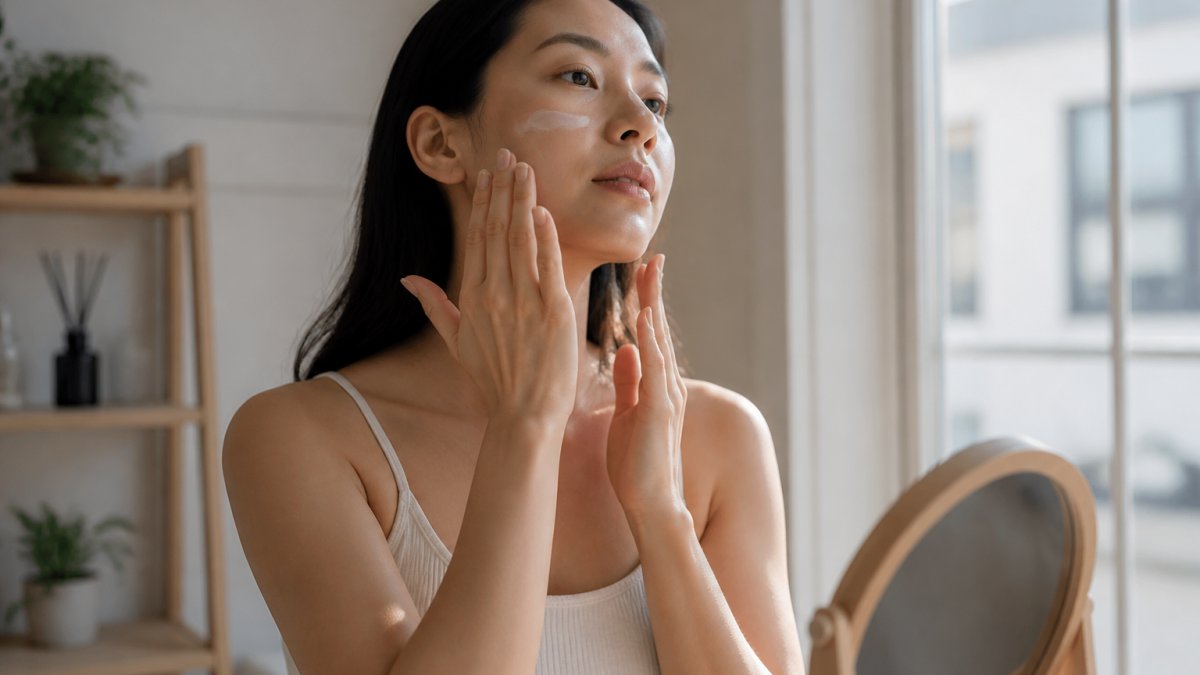
Application technique determines whether your sunscreen actually prevents fine lines. Most people apply far too little, reducing effective SPF and PA protection. The correct amount is about one-quarter teaspoon for face and neck combined, roughly a small marble.
Divide it into five dots: forehead, each cheek, nose, and chin. Press gently with fingertips rather than rubbing, which ensures even distribution and lets the formula set.
Let the sunscreen set 1-2 minutes before makeup. This pause gives UV filters time to form a protective barrier; applying makeup immediately can disrupt it. If your korean sunscreen is the final skincare step before makeup, this pause is non-negotiable.
How Often to Reapply Sunscreen Throughout the Day
Reapplication is where most sunscreen strategies fall apart, the biggest gap between people who prevent fine lines and people who just own a sunscreen. The "every two hours" rule is correct for continuous outdoor exposure but useless as daily-life instruction. Here's a routine that holds up.
The Two-Hour Rule, Translated
The two-hour guidance assumes continuous outdoor daylight, where filters degrade from sweat, sebum, friction, and UV breakdown. Indoors, the math changes:
- Mostly indoors, near a window: UVA passes through glass, so you're still getting exposure. Reapply every 3-4 hours if you're seated near a window for long stretches.
- Mostly indoors, away from windows: One morning application is generally adequate for a normal workday.
- Commuting plus lunch outdoors: Treat the outdoor segments as the trigger. Reapply before your lunch walk if it's more than a few minutes in direct sun.
- Continuous outdoor time (hiking, beach, patio, sports): Every two hours, without exception. After swimming or heavy sweating, reapply immediately, no sunscreen currently sold is truly "waterproof," only water-resistant for a stated duration.
Reapplying Over Makeup Without Ruining It
This practical problem stops most people: you can't smear cream over foundation and expect it to look the same. Four approaches, in order of how well they preserve protection:
- SPF powder or SPF setting spray. Fastest, most makeup-friendly, but the weakest form of top-up. Best used as a supplement, not a replacement, on high-exposure days.
- Targeted sun patches. Adhesive patches that deliver SPF to the highest-risk zones, under-eyes, cheekbones, bridge of the nose, without touching the rest of your makeup. This is where a product like the Revcell Hidden Sun Patch fits: at $40.00 CAD for five pouches containing ten patches total, it's a targeted top-up rather than a full-face reapplication. Best for indoor workdays and short outdoor errands.
- Cushion or stick sunscreen pressed on top. Korean cushions and sunscreen sticks are designed for this. Press (don't swipe) over makeup, then blend edges with a fingertip. Works well for normal and dry skin; oily skin may need a blot first.
- Full reapplication. The gold standard when you're outdoors for hours. Remove or blot makeup, apply the full one-quarter teaspoon, and redo makeup if you care. On beach days and long hikes, this is the only option that gives you the protection you think you have.
A Realistic Daily Routine
A pattern that works for most people with a normal indoor job:

- 7:00 a.m., Apply one-quarter teaspoon of SPF 50+ / PA++++ to face and neck as the last skincare step. Wait 1-2 minutes before makeup.
- 12:00 p.m., Stepping outside for lunch? Top up with a stick, cushion, or sun patch first. Staying in? Skip it.
- 3:00-4:00 p.m., Sitting near a window? Top up with a stick or patch. If not, you're fine.
- 5:30 p.m. commute, If your commute involves direct sun (driving, walking, transit wait), a quick top-up is worth it. UVA through car windows is real exposure.
- Weekend outdoors, Reset to the two-hour rule and reapply fully.
What Actually Undermines Reapplication
- Towel-drying your face after sweating removes a meaningful amount of product. Reapply.
- Touching your face throughout the day, a habit many people have, physically lifts sunscreen from the areas most prone to fine lines (forehead, around the eyes, nasolabial folds).
- Assuming indoor = protected. Window glass blocks UVB but not UVA, so a desk by a window is a slow, steady UVA source.
- Skipping the neck and ears. These are among the first places fine lines and crepiness show, and they're the most commonly missed on reapplication.
How This Connects to Fine Lines
Fine lines from photoaging are cumulative: every unprotected UVA exposure adds to collagen and elastin damage. A morning-only habit that skips lunchtime sun, window exposure, and commutes leaves a meaningful slice of daily UVA unblocked. Topping up at the right moments, even with a stick, patch, or powder, closes that gap without a full makeup reset.
Key Ingredients That Combat Fine Lines and Photoaging
Niacinamide improves barrier function, reduces sebum production, and can minimize fine lines by supporting elasticity. Its anti-inflammatory properties make it useful in sunscreens for sensitive or reactive skin.
Hyaluronic acid provides hydration essential for plump, line-free skin: dehydrated skin looks more lined, while hydrated skin looks fuller and smoother. Korean sunscreens often include multiple molecular weights for surface and deeper hydration.
Rice extract appears in many Korean formulations for its brightening and antioxidant properties. It doesn't directly prevent fine lines, but it supports overall skin health and improves tone irregularities that accompany photoaging.
Common Mistakes That Reduce Sunscreen Effectiveness
The most widespread mistake is applying too little sunscreen.
Another critical error is inconsistent application. Sunscreen prevents fine lines only through consistent daily use; missing days or skipping reapplication lets photoaging progress.
Many people also fail to account for activities that require reapplication. Swimming, sweating during exercise, or towel-drying your face can remove sunscreen, reapply afterward.
A final mistake is choosing the wrong formula for your skin type; selecting the right korean sunscreen fine lines product for your needs dramatically increases consistent use.
The difference between skin that shows fine lines and skin that stays smooth comes down to one factor: consistent UV protection.
Frequently Asked Questions
What's the difference between SPF and PA ratings in Korean sunscreen?
SPF measures protection against UVB rays, which cause sunburn and contribute to photoaging. PA ratings measure UVA protection, which penetrates deeper and accelerates fine lines and wrinkles. A Korean sunscreen labeled SPF 50+ PA++++ offers broad-spectrum protection against both. For fine line prevention, you need both: SPF for surface damage and PA++++ for deep photoaging prevention.
Can daily sunscreen use actually prevent fine lines?
Yes. Consistent daily sunscreen use blocks UV exposure that breaks down collagen and elastin, the proteins responsible for skin firmness. UVA rays specifically trigger photoaging, which accelerates fine lines and wrinkles. Korean sunscreens with high PA ratings and hydrating ingredients like hyaluronic acid and centella asiatica protect against this damage while maintaining skin hydration.
How much sunscreen should I apply to my face?
Apply roughly a quarter-teaspoon (about the size of a pea) to your entire face and neck. Many people apply too little, which reduces protection. For full SPF 50+ coverage, you need adequate coverage. If using multiple products, apply sunscreen as the final step in your routine before makeup or outdoor activities.
Is Korean sunscreen suitable for sensitive or mature skin?
Many Korean sunscreens are formulated specifically for sensitive and mature skin, often featuring gentle mineral filters like zinc oxide, soothing ingredients such as centella asiatica, and hydrating agents like hyaluronic acid and niacinamide. Look for fragrance-free, lightweight formulas with minimal irritants. Korean brands typically offer excellent options for both concerns, though patch testing is recommended if your skin is reactive.