Last Updated: October 29, 2026
Quick Summary
Eco friendly korean beauty is worth supporting when a brand can prove its environmental claims rather than just print them on the box. Verify third-party certifications, check ingredient sourcing, and choose packaging you will actually recycle before you commit.
- Look for a named certifying body, audit date, and scope instead of front-of-pack eco claims.
- Cruelty-free and vegan are separate claims, so check the specific product's certification.
- Score packaging on material type, refillability, recycled content, and disassembly.
- Empty, rinse, and separate containers before recycling, since residue can spoil a batch.
- The Black Bean Bundle costs $92.00 and the Mung Bean Bundle costs $100.00.
Table of Contents
- Why Eco Friendly Korean Beauty Brands Are Worth Your Money
- How to Spot a Truly Eco Friendly K-Beauty Brand
- Cruelty Free Korean Skincare Brands and Vegan Formulas to Look For
- Sustainable Korean Beauty Packaging: What Actually Gets Recycled
- How to Recycle Korean Beauty Containers at Home
- Plant-Based Routines Worth Trying: DumiDang Bean Bundles
- The Trade-Offs: When Green Beauty Costs More Than It Gives
- Build Your Eco Friendly K-Beauty Routine With Avana Beauty
- Frequently Asked Questions
Why Eco Friendly Korean Beauty Brands Are Worth Your Money
The global K-beauty products market is projected to grow from $132.77 billion CAD in 2026 to $288.1 billion CAD by 2034, according to Fortune Business Insights' K-beauty market forecast.
Eco friendly korean beauty is worth your money when a brand can prove its environmental claims, not just print them on the box. A 2023 ResearchGate study on K-beauty brand relationships found that the foreign brand halo effect strongly shapes how consumers connect with Korean beauty labels.
Below, we break down how to separate real sustainability from marketing, which packaging actually gets recycled, and how to build a routine that treats your skin and the planet with equal care.
How to Spot a Truly Eco Friendly K-Beauty Brand
Spotting a genuinely eco friendly Korean beauty brand comes down to two checks: verified certifications and transparent sourcing. Skip the front-of-pack claims and go straight to the documentation.
Read the certification, not the label
Look for third-party certifications with published criteria instead. A brand that lists its certifying body, audit date, and scope is telling you something; one that just says "eco-friendly" in a marketing font is telling you nothing.
Check ingredient sourcing and supply-chain transparency
Ask where the raw materials come from and whether the brand publishes that information. Single-origin ingredients and named suppliers signal a shorter, more accountable supply chain.
The Competition Bureau of Canada's guidance on environmental claims is clear that businesses must be able to substantiate green marketing. That standard gives you a legitimate reason to ask for proof before you buy.
Cruelty Free Korean Skincare Brands and Vegan Formulas to Look For
Cruelty free Korean skincare brands and vegan formulas are a growing part of the market. But the labels are where shoppers get stuck, because "cruelty-free" and "vegan" are not interchangeable. Stop reading the front of the box and start checking what sits behind the claim.
Separate the two claims before you compare brands
A brand can be cruelty-free overall and still sell a formula that contains animal-derived ingredients. It can also sell a vegan formula that was tested on animals by a supplier. Treat them as two separate questions:
- Cruelty-free asks whether the finished product or its ingredients were tested on animals. Look for a named program with published standards, such as Leaping Bunny or the Choose Cruelty Free list, rather than a bunny icon a brand drew itself.
- Vegan asks whether the formula contains animal-derived ingredients. Look for a vegan trademark on the specific product, not just the brand page, since a single line can include beeswax, lanolin, carmine, or honey while the rest of the range does not.
How to verify a claim in under five minutes
Most shoppers never check, which is why the claims persist. Here is the routine we suggest:
- Open the product page and find the full INCI ingredient list, not a "key ingredients" highlight reel.
- Search the list for common animal-derived ingredients: beeswax, lanolin, carmine, honey, propolis, and snail mucin.
- Check whether the certification body is named and whether the certificate covers the specific product or only the brand.
- Look for a certificate date, since a claim from 2019 may not reflect the current supplier.
- If the brand publishes a supplier code of conduct or animal-testing policy, read the scope. A policy covering only the brand's own lab is narrower than one covering suppliers.
The trade-offs nobody puts in a roundup
Vegan and cruelty-free positioning is not free. Plant-derived alternatives to lanolin and beeswax can change texture, shelf life, and how a formula feels on dry or reactive skin.
The Competition Bureau of Canada's guidance on environmental claims sets the same expectation for green and ethical marketing that it does for environmental claims: businesses must be able to substantiate what they print.
Sustainable Korean Beauty Packaging: What Actually Gets Recycled
Sustainable Korean beauty packaging is where good intentions meet hard reality. The gap between "recyclable" on a label and "actually recycled" in your kitchen is where many green claims can fail. This section looks at the full lifecycle: what the package is made of, whether it can be refilled, what recycled content it contains, and what your local program will actually take.
Read packaging in four layers, not one
A useful way to compare brands is to score each package on four layers:
- Material type. Glass, aluminum, and rigid PET and HDPE are the most widely accepted. Mixed-material packages, multilayer laminates, and soft pouches are the hardest to process and are often rejected outright.
- Refillability. A refill pod or pouch cuts plastic per use, but only if the brand sells refills consistently and the outer container survives repeated use. A refill discontinued after one season is not a durable system.
- Recycled content. Post-consumer recycled (PCR) content reduces virgin plastic demand, but it is rarely printed on the pack. Brands that publish a PCR percentage give you a number you can compare; brands that say "recycled packaging" without a figure do not.
Refillable and recyclable formats worth choosing
Prioritize these formats when you shop:
- Refill pods and pouches for products you use daily, which cut plastic per use, provided the brand keeps the refill in stock.
- Glass bottles and jars with removable pumps and caps.
- Aluminum tubes where your local program accepts them.
What actually happens after the bin
Recycling is a market, not a moral act. A container is only recycled if a local program collects it, a processor sorts it, and an end market buys the material.
How to recycle Korean beauty containers at home
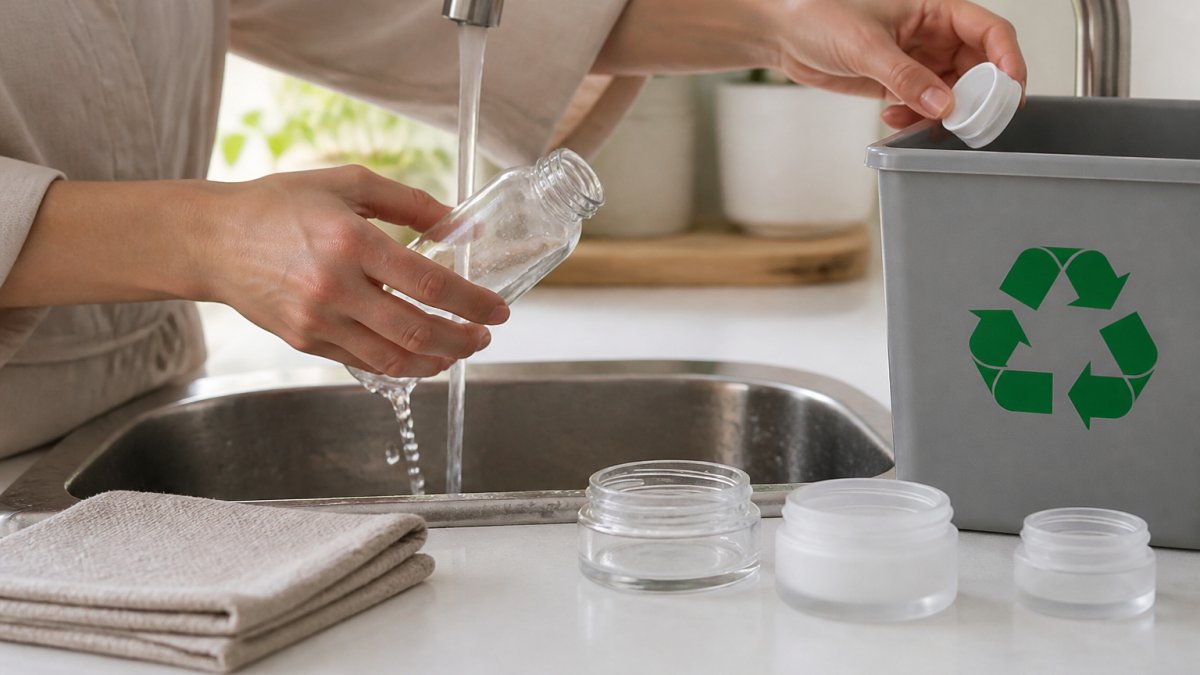
Recycling Korean beauty containers at home starts with three steps: empty, rinse, and separate. Most curbside programs reject containers with product residue or mixed materials, so the prep work matters more than the bin.
Here is the routine we recommend:
- Scrape out as much product as possible with a spatula.
- Rinse the container until no residue remains.
- Remove the pump, dropper, or cap and check whether your municipality accepts that plastic.
- Check your local program's rules, since accepted materials vary by region.
- Drop off specialty items like airless pumps at a beauty packaging take-back point if one operates near you.
The Recycling Council of Canada's recycling directory lists provincial programs and accepted materials. When in doubt, check before you toss, because one contaminated container can spoil a whole batch.
The trade-off to hold in your head
The useful question is which layer matters most for the product you actually use: if you go through a toner every six weeks, refillability and recycled content matter more than a pretty outer box; if you buy a cream twice a year, disassembly and local acceptance matter more. Score the package on the layer that fits your routine, and treat "eco-friendly packaging" as a claim to check rather than a fact to trust.
How to Recycle Korean Beauty Containers at Home
Recycling Korean beauty containers at home starts with three steps: empty, rinse, and separate. Most curbside programs reject containers with product residue or mixed materials, so the prep work matters more than the bin.
- Scrape out as much product as possible with a spatula.
- Rinse the container until no residue remains.
- Remove the pump, dropper, or cap and check whether your municipality accepts that plastic.
- Check your local program's rules, since accepted materials vary by region.
- Drop off specialty items like airless pumps at a beauty packaging take-back point if one operates near you.
The Recycling Council of Canada's recycling directory lists provincial programs and accepted materials. When in doubt, check before you toss, because one contaminated container can spoil a whole batch.
Plant-Based Routines Worth Trying: DumiDang Bean Bundles
Plant-based K-beauty routines are easiest to evaluate when a brand builds a whole regimen around a single botanical. That's the idea behind the DumiDang bean bundles we carry, which pair an essence toner, serum, and cream around one plant ingredient. You can browse the full DumiDang bean skincare line to compare each formula.
Black Bean Bundle for dry, dehydrated-looking skin
The Black Bean Bundle is a complete three-step routine for dry, dull, or dehydrated-looking skin and barrier-supporting care. It combines a 200mL Black Bean Essence Toner, a 50mL Black Bean Serum, and a 50mL Black Bean Cream for $92.00. For a deeper walkthrough, see How to Fix Dehydrated Skin With K-Beauty: A Step-by-Step Guide. See the full Black Bean Bundle and its contents on the product page.

Mung Bean Bundle for calming and balancing
The Mung Bean Bundle targets skin that needs calming, soothing, and balanced moisture care, at $100.00 for the toner, serum, and cream. The essence toner hydrates and prepares skin, the serum delivers concentrated calming care, and the cream locks in moisture. The Mung Bean Bundle page lists the full contents and how to layer them.

The two DumiDang bean bundles pair a toner, serum, and cream around a single plant ingredient.
| Bundle | Best for | Contents | Price |
|---|---|---|---|
| Black Bean Bundle | Dry, dull, dehydrated-looking skin and barrier support | 200mL essence toner, 50mL serum, 50mL cream | $92.00 |
| Mung Bean Bundle | Calming, soothing, balanced moisture care | Essence toner, serum, cream | $100.00 |
The Trade-Offs: When Green Beauty Costs More Than It Gives
Green beauty doesn't always justify its price premium, and pretending otherwise does you no favors.
Consumers are rightly cautious here. Treating "sustainable" as a blanket term is a mistake, and verifying specific environmental and ethical claims is the only reliable filter, as K-Kare's 2026 sustainability guidance points out.
Our rule: pay more for verified sustainability, not for the word itself. If cost and convenience are part of your decision, it helps to know the benefits of buying skincare from local retailers.
Build Your Eco Friendly K-Beauty Routine With Avana Beauty
Building a routine around eco friendly korean beauty brands to support comes down to three habits: verify certifications, choose packaging you'll actually recycle, and buy from brands that publish their sourcing. Get those right, and your routine supports your skin and your values at the same time.
Avana Beauty curates premium Korean skincare for daily self-care. Our collection includes plant-based routines like the DumiDang bean bundles, with ingredient and usage details on their product pages.
Get started with Avana Beauty and build a K-beauty routine you can actually verify, one product at a time.
Frequently Asked Questions
How can I tell if a Korean beauty brand is truly eco friendly?
Look for third-party certification rather than the word sustainable on the front of the box. Check whether the brand publishes specific claims about its packaging material, manufacturing or ingredient sourcing, and whether those claims name a standard or certifier. Treat sustainable as a claim to verify, not a blanket label.
Are there cruelty free Korean skincare brands that also use sustainable packaging?
Yes, and the two often overlap. Many Korean brands now pair cruelty-free and vegan positioning with lighter packaging, refill formats or recyclable materials. When you shop, check both claims separately: cruelty-free refers to animal testing, while packaging sustainability refers to materials and disposal. A brand can be strong on one and weak on the other, so confirm each one on the product page before you buy.
How do I recycle Korean beauty containers properly?
Empty and rinse each container first, then separate what you can. Check your local recycling rules before tossing containers, since accepted materials vary by municipality.
Where can I buy sustainable Korean beauty products?
Buy from a retailer that tells you where its stock comes from and how it ships. Avana Beauty carries curated Korean skincare with plant-derived ingredients, including the DumiDang bean bundles, which start at $88.00 CAD.
Is eco friendly K-beauty as effective as conventional skincare?
Look at what each product is formulated for, such as barrier support, hydration or calming care, and match it to your skin. The DumiDang Black Bean Bundle, for example, is built for dry, dull or dehydrated-looking skin with a toner, serum and cream routine. Effectiveness comes from consistent use of the right formula, not from the sustainability claim alone.