Last Updated: October 25, 2026
Quick Summary
Managing fungal acne with korean beauty products involves screening ingredients for Malassezia triggers like heavy oils and occlusive silicones, then building a consistent routine with gentle cleansing, hydrating toner, calming serum, fungal acne-safe moisturizer, sunscreen, and weekly patch testing. Introduce one product at a time and wait 1-2 weeks to monitor your skin's response before adding the next step.
- Scan product ingredient lists for heavy oils, fatty acids, and occlusive silicones that feed Malassezia yeast.
- Introduce one new product per week and patch test on a small area for 24-48 hours before full-face use.
- A complete routine includes gentle cleanser, hydrating toner, calming serum, moisturizer, sunscreen, and optional clarifying pads 2-3 times weekly.
- Key Korean beauty ingredients for fungal acne include mung bean extract, galactomyces ferment filtrate, and Centella asiatica.
- Support your skincare routine by showering after sweating, wearing breathable fabrics, and keeping skin dry to reduce Malassezia growth.
Table of Contents
- Understanding Fungal Acne vs. Acne Vulgaris
- Why Malassezia and Ingredient Screening Matter
- Building a Korean Skincare Routine for Fungal Acne
- Patch Testing and Gradual Product Introduction
- When Skincare Alone Isn't Enough
- Start Your Fungal Acne-Safe Routine Today
- Frequently Asked Questions
Understanding Fungal Acne vs. Acne Vulgaris
If you're not sure which type you have, talk to a dermatologist.
Why Malassezia and Ingredient Screening Matter
- Heavy oils such as coconut oil, mineral oil, and isopropyl myristate
- Certain fatty acids and esters that supply the yeast with lipids
- Occlusive silicones in high concentrations, which trap moisture and heat
- Some plant oils marketed as "natural" or "soothing"
A repeatable screening method
- Pull the current full ingredient list from the brand's own product page or the packaging, not from a retailer thumbnail or a years-old blog post.
- Scan for the trigger categories above, paying attention to where they sit in the list, ingredients near the top are present in higher concentrations.
- Check the formula date or batch information when the brand publishes it, and re-check the list if you repurchase, because reformulations are common.
- Cross-reference the product against a second source only to confirm the list is current, not to outsource the decision.
- Patch test before committing, because a clean screen still does not prove your skin will tolerate the formula.
The Canadian Dermatology Association guidance on fungal skin infections
Building a Korean Skincare Routine for Fungal Acne
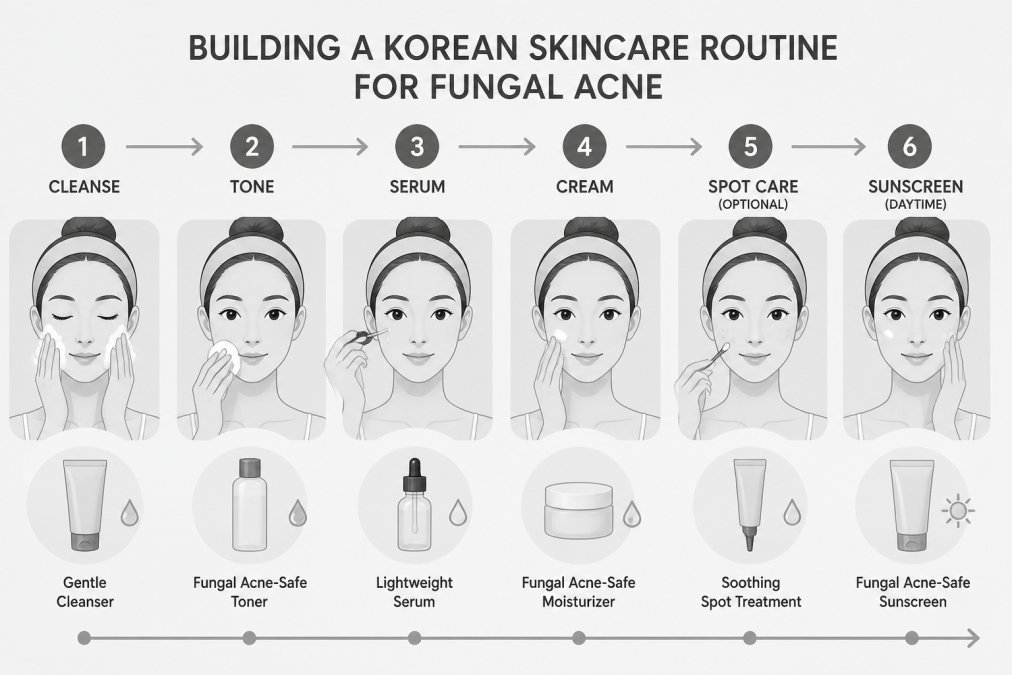
The key is consistency and patience: introduce one new product at a time, wait 1-2 weeks, and monitor how your skin responds. Discover how K-Beauty addresses sensitivity concerns for fungal acne-prone skin. Rushing or mixing too many new products makes it impossible to know which one caused a reaction.
Step 1: Gentle Cleansing to Start Your Routine
Cleanse morning and night: a quick lukewarm rinse in the morning, and a thorough cleanse at night to remove all sunscreen, sweat, and grime.
Step 2: Apply a Hydrating Toner
Dumidang Black Bean Essence Toner is formulated for sensitive and dehydrated skin. It features mung bean extract, galactomyces ferment filtrate, bifida ferment extract, and Centella asiatica extract.
Step 3: Use a Calming Serum
The DumiDang Mung Bean Serum includes mung bean extract, tea tree leaf oil, green tea extract, and hyaluronic acid.
other serums
Step 4: Lock In Hydration With a Fungal Acne-Safe Moisturizer
The DumiDang Mung Bean Cream is formulated for sensitive, combination, oily, and dehydrated skin. It absorbs comfortably without residue. The formula includes mung bean extract, galactomyces ferment filtrate, bifida ferment extract, and Centella asiatica extract.

Step 5: Apply Fungal Acne-Safe Sunscreen
Apply sunscreen last in your morning routine, at least 15 minutes before sun exposure, and reapply every two hours outdoors. At night, remove it with your gentle cleanser to prevent buildup.
DumiDang Mung Bean Cream (50g) →
Step 6: Evening Oil-Free Treatment
Clarifying pads with gentle actives can also help 2-3 times per week on breakout-prone areas. Don't overuse, too much exfoliation damages your barrier and triggers more breakouts.
Adapt the routine to your skin type and budget
- **
- **
- **
- **
- **
DumiDang Mung Bean Bundle combines toner, serum, and cream.
Patch Testing and Gradual Product Introduction
- Start with one new product per week
- Apply it to a small area first (your jawline or behind your ear)
- Wait 24-48 hours and watch for redness, itching, or new breakouts
- If no reaction, gradually increase usage to your full face
- Keep using it for 1-2 weeks before adding the next product
When Skincare Alone Isn't Enough
Also consider lifestyle: sweat, humidity, and tight clothing create environments where Malassezia thrives. Shower after sweating, wear breathable fabrics, and keep skin dry to support your routine and reduce breakouts.
Start Your Fungal Acne-Safe Routine Today
At Avana Beauty Inc, we've curated a selection of premium Korean skincare and beauty products. Our DumiDang Mung Bean Bundle combines toner, serum, and cream.
The bundle includes the Dumidang Black Bean Essence Toner for hydration, the DumiDang Mung Bean Serum for calming care, and the DumiDang Mung Bean Cream to lock in moisture.
The American Academy of Dermatology guidance on folliculitis and yeast infections
| Step | Product Type | Key Ingredients | Frequency |
|---|---|---|---|
| 1 | Gel or micellar base | Twice daily | |
| 2 | Hydrating Toner | Hyaluronic acid, botanical extracts | Twice daily |
| 3 | Calming Serum | Tea tree oil, green tea, hyaluronic acid | Twice daily |
| 4 | Mung bean extract, Centella asiatica | Twice daily | |
| 5 | Mineral or chemical, non-comedogenic | Daily (AM only) | |
| 6 | Azelaic acid or clarifying pads | 2-3 times weekly |
Frequently Asked Questions
How can I tell if my breakouts are fungal acne rather than regular acne?
Fungal acne typically appears as small, uniform bumps, often on the chest, back, or forehead, and tends to itch or feel tender. Unlike acne vulgaris, which has blackheads and whiteheads, fungal acne caused by Malassezia yeast presents as folliculitis with consistent-sized pustules. If over-the-counter acne treatments worsen your breakouts or show no improvement after 4-6 weeks, fungal acne may be the cause. A dermatologist can confirm diagnosis through examination or culture.
What Korean skincare ingredients are safe for fungal acne?
The DumiDang Mung Bean Cream and Essence Toner list mung bean extract, galactomyces ferment filtrate, bifida ferment extract, and Centella asiatica extract. The DumiDang Mung Bean Serum lists mung bean extract, tea tree leaf oil, green tea extract, and hyaluronic acid.
How long should I use a new fungal acne routine before I see results?
Allow 4-6 weeks of consistent use before assessing results. Fungal acne responds more slowly than bacterial acne, and skin barrier repair takes time. During this period, track redness, irritation, and breakout frequency in a journal. If your skin worsens or shows no improvement after 6 weeks, discontinue and consult a dermatologist. Consistency matters, skipping steps or switching products frequently will prevent you from seeing whether the routine actually works.
Should I see a dermatologist if I suspect fungal acne?
Yes, if over-the-counter skincare and topical treatments do not improve breakouts after 6-8 weeks, or if breakouts spread or worsen. A dermatologist can confirm fungal acne through examination and may prescribe antifungal treatments such as oral medications or prescription topicals. Skincare alone may not be sufficient for moderate to severe fungal acne. Early professional evaluation prevents prolonged frustration and ensures you receive the right treatment.
If you're unsure whether your breakouts are fungal acne, Health Canada's resource on skin conditions and when to seek care provides guidance on recognizing different types of skin infections and when professional evaluation is needed. Understanding what you're treating is the first step to clear skin.