Last Updated: November 4, 2026
Quick Summary
Purchasing counterfeit korean beauty products exposes your skin to heavy metals like lead and mercury, bacteria and mold from unsterile production, and banned substances never meant for skin contact. These unregulated ingredients can strip your skin barrier, causing irritation, redness, and dryness, and legal recourse is usually nonexistent because sellers are anonymous.
- Counterfeiters copy packaging down to the batch code format, making fakes hard to spot.
- Scan the barcode and confirm it resolves to the actual brand, not a generic listing.
- Verify batch codes through the brand itself, since third-party apps have incomplete databases.
- Gray-market imports are genuine products sold through unauthorized channels; counterfeits are fake from the start.
- In Canada, report consumer complaints to the Competition Bureau and safety concerns to Health Canada.
Table of Contents
- Why Counterfeit K-Beauty Is a Growing Problem
- Counterfeit K-Beauty Health Risks You Can't Ignore
- How to Spot Fake Korean Skincare Before You Buy
-
How to Check Korean Skincare Authenticity Step by Step
- Step 1: Confirm the seller is authorized before you look at the product
- Step 2: Locate and read the batch code correctly
- Step 3: Verify the batch code through the brand, not a third-party app
- Step 4: Scan the barcode and read what it resolves to
- Step 5: Compare packaging against the brand's official images
- Step 6: Sanity-check the expiration date and storage
- Step 7: Patch test, then watch for delayed reactions
- Step 8: Keep the receipt and the packaging
- Gray-Market Imports vs. True Counterfeits
- What to Do If You Bought Counterfeit Skincare
- Buying Authentic K-Beauty from a Trusted Canadian Retailer
- Frequently Asked Questions
Why Counterfeit K-Beauty Is a Growing Problem
The risks of purchasing counterfeit Korean beauty products start with a simple truth: fakes are getting harder to spot.
Shoppers want the glow, not a gamble.
- K-beauty's popularity outpaces the number of authorized sellers
- Counterfeiters copy packaging down to the batch code format
- Online marketplaces make it easy to list fakes and disappear
The result is a market where product integrity is no longer guaranteed by the label alone. Here's how to tell real from fake, and why it matters for your skin.
Counterfeit K-Beauty Health Risks You Can't Ignore
The biggest risk isn't wasted money. It's what's inside the bottle. Counterfeit K-beauty health risks range from mild irritation to serious dermatological reactions, and the worst part is you often can't predict which you'll get.
Contaminants Found in Knock-Off Formulas
Fakes are made cheaply, and that shows up in the formula. Common problems include:
- Heavy metals like lead and mercury, sometimes used to brighten a product fast
- Bacteria and mold from unsterile production and poor preservation
- Substandard ingredients swapped in to cut costs
None of these belong on your face. Dermal absorption means whatever sits on your skin can pass into your body. A knock-off serum isn't just ineffective; it can be actively harmful.
What Unregulated Ingredients Do to Your Skin Barrier
Your skin barrier holds moisture in and keeps irritants out. Unregulated ingredients can strip it, causing irritation, redness, dryness, and a cycle of reactions that's hard to break.
For anyone with sensitive or reactive skin, the stakes are higher. Our barrier repair collection gathers soothing Korean formulas made for exactly this kind of recovery.
How to Spot Fake Korean Skincare Before You Buy
Knowing how to spot fake Korean skincare comes down to a few concrete checks.
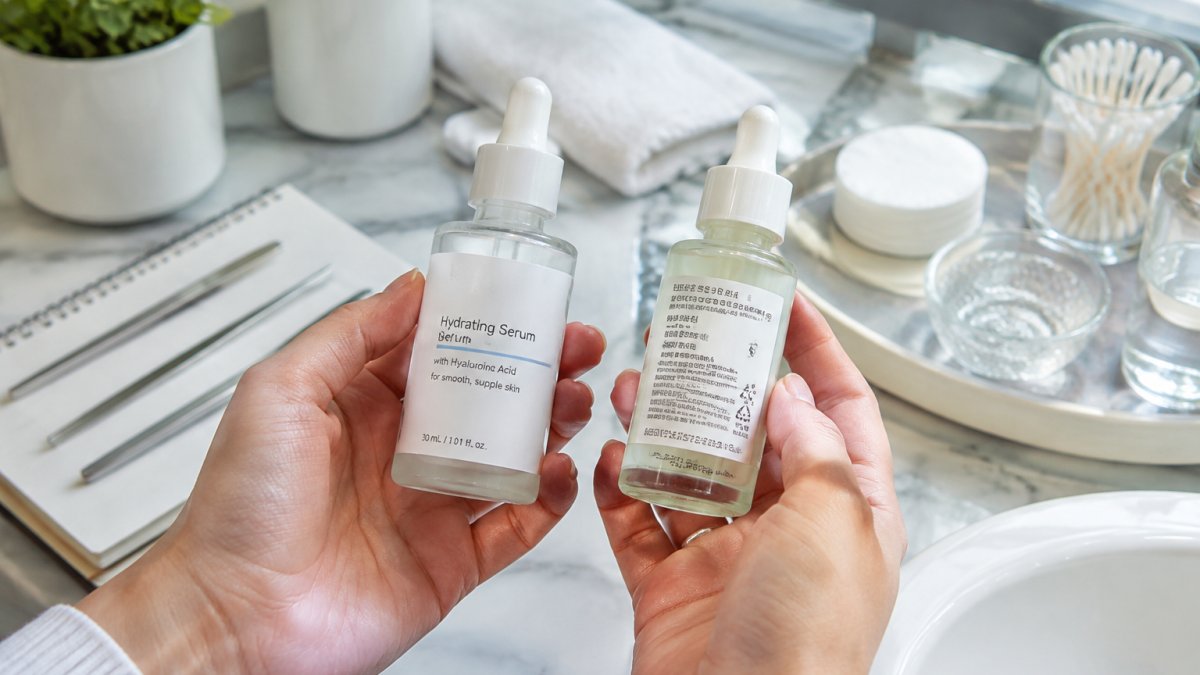
Start with the seller. An authorized retailer can show you where stock comes from. A marketplace listing usually can't.
For a deeper walkthrough, our guide on how to identify authentic K-beauty products breaks the checks down step by step.
Packaging Inconsistencies and Barcode Red Flags
Packaging inconsistencies are often the first clue. Look for:
- Misspelled words or blurry printing on the label
- Fonts that don't match the brand's official design
- A batch code that's missing, smudged, or stuck on as a sticker
Barcode verification matters too. Scan the barcode and confirm it points to the actual brand, not a generic or mismatched listing. A barcode that won't scan or leads nowhere is a red flag.
Why a Price That Looks Too Good Should Raise Alarm
A price that seems too good usually is. Quality K-beauty carries real costs: formulation, testing, packaging, and shipping. A deeply discounted "import" often skips some of them.
If a seller offers a premium ampoule at a fraction of what authorized retailers charge, ask why. The answer is usually that it isn't the real product.
How to Check Korean Skincare Authenticity Step by Step
Most guides tell you to "check the batch code" and stop there, which is useless without knowing what a batch code is, where it lives, and what a brand can confirm.
Step 1: Confirm the seller is authorized before you look at the product
Start with the seller, not the bottle. An authorized retailer can name the distributor or brand account it buys from; a marketplace listing usually cannot. Check the brand's store locator or authorized-retailer page for the seller's business name, and if it does not appear, treat the listing as unverified regardless of the photos.
Step 2: Locate and read the batch code correctly
A batch code (or lot number) is the manufacturer's production identifier, usually stamped, inkjet-printed, or embossed on the container bottom, tube crimp, or back label near the expiration date.
- Read it exactly, including letter case and any separators.
- Compare its format to the brand's known format; counterfeiters often copy the look of a batch code but use a format the brand never issues.
- A batch code that is a sticker applied over the original print, or that is smudged and unreadable, is a warning sign.
Watch out: a batch code that "looks right" proves nothing on its own, because a counterfeiter can print a plausible code on a fake bottle; it only helps when you verify it through the brand.
Step 3: Verify the batch code through the brand, not a third-party app
Many Korean brands offer a verification channel: a customer-service email, website form, or official app where you enter the batch code and product name, and some publish batch-code format guides. Third-party scanning apps have incomplete databases and can flag genuine products as fake, so treat an app result as a prompt to contact the brand, not a verdict.
Step 4: Scan the barcode and read what it resolves to
The barcode on a retail product is typically a GTIN (in North America, a UPC-A or EAN-13). Scanning it should resolve to the correct brand and product name; one that won't scan, resolves to a different product, or leads to a generic listing is a red flag. Barcodes are easy to copy, so a correct one confirms the packaging matches a real product, not that the contents are genuine.
Step 5: Compare packaging against the brand's official images
Use the brand's own product page, not a marketplace photo, as your reference. Check font weight, line spacing, seal position, language mix on the label, and cap finish; counterfeits tend to fail on small typographic details and seal quality.
Step 6: Sanity-check the expiration date and storage
An expiration date should be printed in the brand's format and be plausible for the product's shelf life. A date years in the future, missing, or in a different format is a warning sign. Also consider storage: a genuine product kept in a hot warehouse or direct sun can degrade before its date.
Step 7: Patch test, then watch for delayed reactions
Apply a small amount to your inner forearm and wait 24 to 48 hours. A single patch test catches immediate irritation but not delayed reactions, so watch the area for several days and stop using the product if anything develops.
Step 8: Keep the receipt and the packaging
If something goes wrong, the receipt, the outer box, and the batch code are your evidence. Photograph them before you throw anything away.
For a companion checklist with more detail, see our guide on how to identify authentic Korean skincare.
That is the practical side. The next question is what to do when a product is questionable but not obviously fake, which is where the gray market comes in.
Gray-Market Imports vs. True Counterfeits
Gray-market products and counterfeits are not the same thing, and the difference matters for both your skin and your recourse. Gray-market goods are genuine products sold through unauthorized channels, often parallel-imported and resold outside the brand's approved distribution; counterfeits are fake products made to look real. Counterfeiters rely on that confusion.
The practical difference
| Factor | Gray-Market Import | True Counterfeit |
|---|---|---|
| Product origin | Genuine brand | Fake, unlicensed |
| Supply chain | Unauthorized but often traceable | Opaque, often untraceable |
| Main risk | Poor storage, expired stock, no brand support | Contaminants, no safety testing |
| Recourse if it fails | Limited; sometimes the importer | Usually none |
A gray-market import can still be a genuine product stored badly, shipped without temperature control, or sold past its ideal date. A counterfeit has no real formula behind it from the start. Both carry risk, but only the counterfeit carries the contaminant risk described earlier.
How to assess supply-chain transparency
You cannot audit a seller's chain, but you can ask questions that separate a traceable gray-market seller from an opaque one:
- Who is the importer of record? A legitimate importer can name itself and often appears on the label or the shipping documents.
- Can the seller name the distributor? A seller who can name an authorized distributor is more traceable than one who says only "direct from Korea."
- Is the stock parallel-imported or brand-authorized? Parallel imports are legal in Canada but sit outside the brand's warranty and support.
Watch out: a seller who answers these questions vaguely is not necessarily selling counterfeits, but the lack of traceability is itself the risk, because you have no one to hold accountable if the product fails.
Why the distinction changes your recourse
If a gray-market product causes a reaction, you may have a path back to the importer or retailer, and the product is at least a real formula that can be identified.
Supply-chain transparency is the practical test: a seller who can show where stock came from, and who stands behind it, is a safer bet than one who cannot, even when both sell outside the brand's official channel.
What to Do If You Bought Counterfeit Skincare
If you suspect you bought a fake, act quickly. Here's what to do if you bought counterfeit skincare:
- Stop using the product immediately. Don't finish the bottle to "see if it works."
- Photograph everything. Keep the packaging, batch code, and receipt.
- Report the seller. Flag the listing on the marketplace where you bought it.
Legal recourse for victims is often limited, especially with anonymous online sellers. That's why prevention beats cleanup. The best protection is buying from a source you can hold accountable.
Buying Authentic K-Beauty from a Trusted Canadian Retailer
The safest path is the simplest: buy from a retailer that stands behind its stock.
Read why buying from Canadian retailers makes sense and the benefits of shopping with a local retailer.
Avana Beauty Inc curates premium Korean skincare. If you're ready to skip the gray market and shop with confidence, start with our curated collection and find the formulas that fit your skin.
Frequently Asked Questions
What are the risks of using counterfeit Korean beauty products?
Counterfeit Korean beauty products can contain heavy metals like lead and mercury, bacteria from unregulated manufacturing, and substandard ingredients that trigger contact dermatitis or allergic reactions. Because these products bypass quality control entirely, the label may not match what's inside the bottle. Dermal absorption means anything applied to your skin can enter your system, so the risk goes beyond surface irritation. Patch testing a small area first and buying only from authorized retailers are the two most reliable safeguards.
How can you tell if a Korean skincare product is fake?
Check the batch code and expiration date for consistent printing and placement. Look for packaging inconsistencies such as misspelled brand names, blurry text, or a different font weight than the official product. Scan the barcode with a verification app and compare it against the brand's official listing. Seals should be intact and unbroken. If the price sits far below what authorized retailers charge, treat that as a red flag and verify before applying anything to your face.
Is it safer to buy Korean skincare from an authorized retailer?
Yes. Authorized retailers source directly from the brand or its approved distributor, so supply chain transparency is documented from factory to shelf. That means batch codes trace back to real production runs and storage conditions meet regulatory compliance standards. Buying from an authorized retailer also gives you recourse if something goes wrong, since you have a receipt and a business accountable for what it sold you. Gray-market sellers offer no such protection.
What should I do if I think I bought fake Korean skincare?
Stop using the product immediately and photograph the packaging, batch code, and receipt. Report the seller to the brand's customer service team so they can investigate IP infringement. Check the official websites of Canadian consumer and health authorities for current reporting steps. See a dermatologist if irritation persists. Keep the product as evidence rather than discarding it, and request a refund through your payment provider if the seller won't cooperate.