Table of Contents
- Understanding Sensitive Skin and K-Beauty
- Step 1: Start with Gentle K-Beauty Cleansers for Sensitive Skin
- Step 2: How to Patch Test Skincare Products Safely
- Step 3: Layer Hydration with Toners, Essences, and Serums
- Step 4: Strengthen Your Skin Barrier with Best Soothing K-Beauty Ingredients
- Step 5: Moisturize and Protect Daily
- Common Mistakes to Avoid When Building Your K-Beauty Routine
- Frequently Asked Questions
Last Updated: September 19, 2026
Understanding Sensitive Skin and K-Beauty
Sensitive skin reacts strongly to products, environmental changes, or stress, which is why a K-beauty routine sensitive skin approach focuses on calming, hydrating ingredients rather than harsh actives. It often shows redness, irritation, dryness, or tightness. A K-beauty routine for sensitive skin focuses on calming, hydrating ingredients rather than harsh actives.
K-beauty prioritizes hydration, fermented extracts, and gentle formulations over aggressive treatments, an approach that builds resilience without triggering reactions in sensitive skin.
The key difference between a routine that calms your skin and one that worsens it comes down to product selection and application order.
A solid K-beauty routine sensitive skin rebuilds your barrier, the outer layer that protects against irritants and locks in moisture, through layering hydrating, soothing products.
Step 1: Start with Gentle K-Beauty Cleansers for Sensitive Skin
Gentle K-beauty cleansers for sensitive skin remove makeup and impurities without disrupting your skin's natural pH or protective oils, which harsh cleansers strip away.
If you strip your barrier during cleansing, no amount of hydrating serums will fully repair the damage.
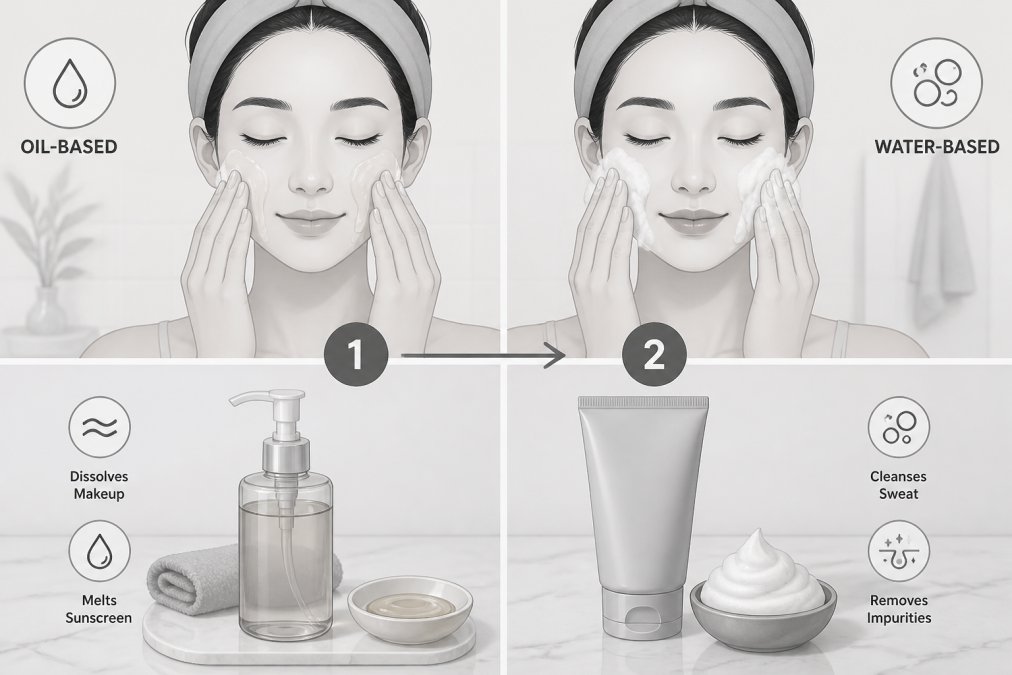
Why Double Cleansing Matters for Sensitive Skin
Double cleansing removes makeup, sunscreen, and oil-based impurities without over-stripping: the first cleanser dissolves oil, the second removes water-soluble residue.
Skipping double cleansing leaves makeup residue that traps bacteria and irritants, worsening inflammation.
Oil-Based vs. Water-Based: Finding Your Balance
An oil-based cleanser dissolves makeup and sebum; look for lightweight formulas with jojoba, squalane, or rice bran oil that mimic your skin's natural sebum.
A water-based cleanser removes oil residue and remaining impurities; choose a gentle gel or cream formula with hydrating ingredients like centella asiatica or hyaluronic acid, avoiding sulfates.
The right oil cleanser reduces breakouts by removing impurities thoroughly without harsh scrubbing.
Step 2: How to Patch Test Skincare Products Safely
How to patch test skincare products prevents full-face reactions and saves you from weeks of irritation.
Apply the product to a small patch behind your ear or on your inner arm once daily for 3-5 days, watching for redness, itching, burning, or swelling.
Five days of testing prevents disasters and weeks of recovery time.
After patch testing passes, use the product every other day for the first week, then move to daily use to let your skin adapt gradually.
When a Product Triggers a Reaction: The SOS Recovery Protocol
Even with careful patch testing, a new product may cause a flare-up; this means your barrier needs immediate support.
Immediate steps (first 24 hours):
- Stop using the offending product immediately. Do not continue "to see if it gets better." Continued exposure deepens inflammation.
- Simplify to your core routine. Use only your gentlest cleanser, a hydrating toner, and a barrier-repair moisturizer for the next 3-5 days. Skip all other products, including sunscreen if it contains chemical filters (switch to mineral-only if needed).
- Cool compress, not ice. Apply a clean, damp cloth cooled with lukewarm water for 10-15 minutes. Avoid ice, which can shock sensitive skin further.
- Hydrate from within. Drink extra water. Dehydration worsens inflammatory responses.
Days 2-7 (barrier repair phase):
Focus on ceramides and centella asiatica, which actively repair a compromised barrier. Apply a ceramide-rich moisturizer twice daily, looking for Ceramide NP, Ceramide AP, or Ceramide EOP in the first five ingredients.
During this phase, avoid:
DumiDang Mung Bean Essence Toner (200mL) →
- Any active ingredients (vitamin C, niacinamide, acids, retinol)
- Fragrance, essential oils, and alcohol
- Physical or chemical exfoliation
- Layering more than three products
Days 8-14 (reintroduction):
Once redness and irritation subside, slowly reintroduce your other products one at a time, spacing them 2-3 days apart.
Understanding Ingredient Interactions to Prevent Reactions
Not all reactions are allergies, many are caused by ingredient incompatibility. Certain combinations amplify irritation even if each product is gentle alone.
Common problematic combinations for sensitive skin:
- Niacinamide + acids: Niacinamide can increase skin sensitivity when combined with chemical exfoliants. If using both, space them 12 hours apart or use on alternate days.
- Multiple hydrating humectants: Layering hyaluronic acid, glycerin, and propylene glycol in the same routine can over-hydrate and destabilize the barrier if not sealed with an occlusive moisturizer.
- Fermented extracts + vitamin C: Both are potent and can overwhelm sensitive skin when used together. Introduce one, wait 2 weeks, then add the other.
- Centella asiatica + retinol: While both are beneficial, combining them too early can cause irritation. Use centella for 3-4 weeks before introducing retinol, and even then, use retinol only 1-2 times weekly.
Step 3: Layer Hydration with Toners, Essences, and Serums
Layering hydrating products is the core of K-beauty, building hydration depth that single products can't achieve.
Step 4: Strengthen Your Skin Barrier with Best Soothing K-Beauty Ingredients
Your skin barrier needs specific ingredients to repair and strengthen. Best soothing K-beauty ingredients reduce inflammation and lock in moisture. These ingredients are non-negotiable for sensitive skin.
Ceramides and Centella Asiatica for Barrier Repair
Ceramides are lipids that fill gaps in your skin barrier and prevent water loss (pubmed.ncbi.nlm.nih.gov). Sensitive skin often has lower levels, so adding ceramides topically restores barrier function.
Hyaluronic Acid and Fermented Extracts for Deep Hydration
Hyaluronic acid holds up to 1000 times its weight in water, providing deep hydration without irritation.
Step 5: Moisturize and Protect Daily
A moisturizer seals everything in; for sensitive skin, choose a cream rather than a lotion, as creams contain more occlusive ingredients that prevent water loss.
When Your Barrier Is Ready: Introducing Active Ingredients Safely
Once your sensitive skin has stabilized, typically after 4-6 weeks of consistent hydration and barrier repair, you may want to introduce gentle actives like azelaic acid, low-dose niacinamide, or a mild exfoliant. However, timing and sequencing are critical to avoid triggering a relapse.
The safe introduction protocol for actives:
Active ingredients safe for sensitive skin (when introduced correctly):
- Azelaic acid (10-20%): Calms rosacea and reduces inflammation; start at 10% concentration.
- Niacinamide (2-5%): Strengthens the barrier and reduces redness at low concentrations.
- Gentle enzyme exfoliants: Rice bran or papaya enzymes; use once weekly maximum.
- Low-dose retinol (0.25-0.5%): Use 1-2 times weekly with extra moisturizer.
Ingredients to avoid even after barrier recovery:
- High-concentration vitamin C (L-ascorbic acid above 10%)
- Benzoyl peroxide (too drying and irritating)
- Strong chemical exfoliants (glycolic acid above 10%, salicylic acid)
- Essential oils and fragrance
- Alcohol denat
The "sandwich method" for sensitive actives:
Common Mistakes to Avoid When Building Your K-Beauty Routine
Introducing too many products at once is the biggest mistake; add one product every 1-2 weeks so you can identify which causes irritation.
Frequently Asked Questions
Is Korean skincare suitable for sensitive skin?
Yes, K-beauty routines can work well for sensitive skin when you choose the right products. Many Korean brands focus on gentle, hydrating formulas with soothing ingredients like centella asiatica and ceramides. The key is starting slowly, patch testing each product, and avoiding common irritants such as fragrance and essential oils. Not all K-beauty products are suitable for sensitivity, which is why careful selection and gradual introduction are essential.
What are the best soothing ingredients in K-beauty products?
Top soothing K-beauty ingredients include centella asiatica (cica), which reduces redness and supports barrier repair; ceramides, which lock in moisture and strengthen the skin barrier; hyaluronic acid, which provides deep hydration without heaviness; and fermented extracts like bifida ferment, which calm inflammation and improve skin texture. Products like the DumiDang Mung Bean line combine several of these, the toner and cream both contain centella asiatica, mung bean extract, and fermented ingredients designed specifically for reactive skin.
How do I patch test new Korean skincare products before using them on my face?
Apply a small amount of the new product to a discreet area behind your ear or on your inner arm. Wait 24-48 hours and observe for redness, itching, burning, or any reaction. If no irritation appears, apply a small amount to a small area of your face (like your jawline) for 3-5 days before incorporating it into your full routine. This gradual approach is especially important for sensitive skin, as it allows you to identify problem products before they affect your entire face.
Can I use a full K-beauty routine if I have sensitive skin?
A simplified version works better than a 10-step routine for most sensitive skin types. Start with a gentle cleanser, hydrating toner, lightweight serum, and moisturizer, then add sun protection. Once your skin adapts, you can slowly introduce essences or targeted treatments. The goal is to strengthen your skin barrier first, then layer in active ingredients. Rushing into a complex routine can overwhelm reactive skin and trigger irritation or barrier damage.